
Plausible Analytics
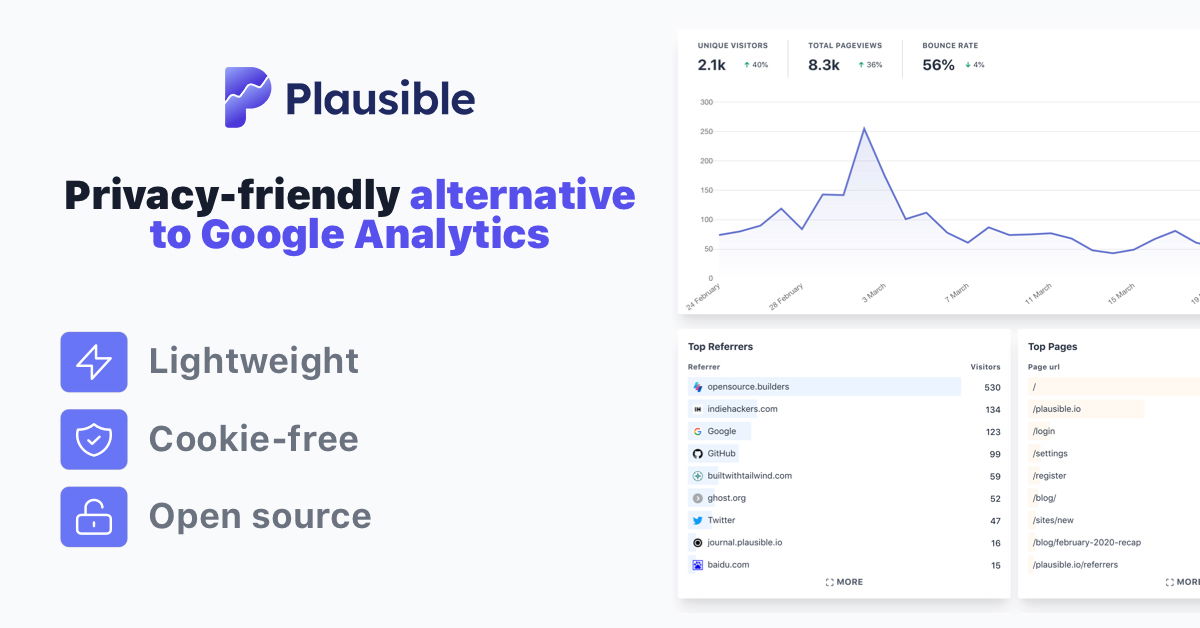
Plausible is a lightweight and open-source Google Analytics alternative. Your website data is 100% yours and the privacy of your visitors is respected.
Free tier available, subscription-based pricing (specific tier prices not shown in provided text)
| Dimension | Score | Evidence | Confidence |
|---|---|---|---|
| Market size | Virtually every website on the internet needs some form of analytics — hundreds of millions of domains globally. The privacy-first segment is growing but remains a fraction of total analytics users. SMBs, SaaS founders, agencies, and indie creators are all reachable via content marketing and Product Hunt-style launches. TAM is large, SAM is still maturing. | M | |
| Timing trend | Strong tailwind: GDPR enforcement is ramping up across Europe (major fines issued 2023–2024), US state privacy laws are multiplying (CCPA, VCDPA, etc.), and EU regulators have specifically targeted Google Analytics in several countries. GA4's poor reception continues to drive churn from Google. AI-powered analytics is an emerging trend that could reset the playing field for new entrants. | H | |
| Defensibility | Plausible itself is open source, meaning its core product can be forked. However, brand trust, SEO moat (thousands of backlinks and comparison articles), and an established community give incumbents a strong lead. A straight clone would struggle badly. Differentiation requires a genuinely novel angle — e.g., vertical-specific analytics, AI-driven insights, or a superior self-hosted experience — to carve out a defensible niche. | H | |
| Pain severity | GDPR/CCPA compliance is a legal necessity for most web businesses, not just a nice-to-have. Cookie consent banners are despised by users and hurt conversion rates. Google Analytics 4's notoriously poor UX has intensified the pain, driving a visible migration wave away from GA. The problem is real, recurring, and daily. | H | |
| Willingness to pay | Plausible charges $9–$19+/mo depending on pageviews and has a healthy paying customer base (publicly shared ~$1M+ ARR milestones). However, the existence of free tiers (Plausible self-host, Umami, Fathom free tier) and free Google Analytics creates pricing pressure. Developers especially gravitate toward free/self-hosted options, compressing WTP for hosted solutions. | H | |
| Execution complexity | Building a basic privacy-first analytics product is achievable — open source codebases like Plausible and Umami provide reference implementations. The hard parts are ingestion pipeline reliability at scale, handling billions of events efficiently (ClickHouse expertise required), building a polished UI, and maintaining compliance documentation. A solo founder can ship an MVP but reaching production-grade quality at scale requires meaningful engineering investment. | M | |
| Competition intensity | The privacy-first analytics space is increasingly crowded: Plausible, Fathom Analytics, Simple Analytics, Umami (open source), Matomo, Cabin, Pirsch, Splitbee (acquired by Vercel), Cloudflare Web Analytics (free), and PostHog all occupy overlapping territory. Google Analytics 4 remains the dominant free incumbent. This is no longer a blue ocean. | H |
Reasoning
The privacy-first analytics space has genuine, growing demand fueled by regulatory tailwinds and GA4 backlash, but it is no longer open territory — Plausible, Fathom, Umami, and a half-dozen others have already colonized the "simple, privacy-friendly" positioning. A straight Plausible clone would be a capital-destroying exercise in fighting entrenched brand SEO and open-source forkability. A founder should only enter this market with a sharp, defensible wedge: think vertical-specific analytics (e.g., Shopify stores, newsletter platforms, mobile apps), AI-native insights layered on raw event data, or a white-label analytics infrastructure play targeting agencies — not another generic lightweight dashboard.
No tech stack data