
Pirsch
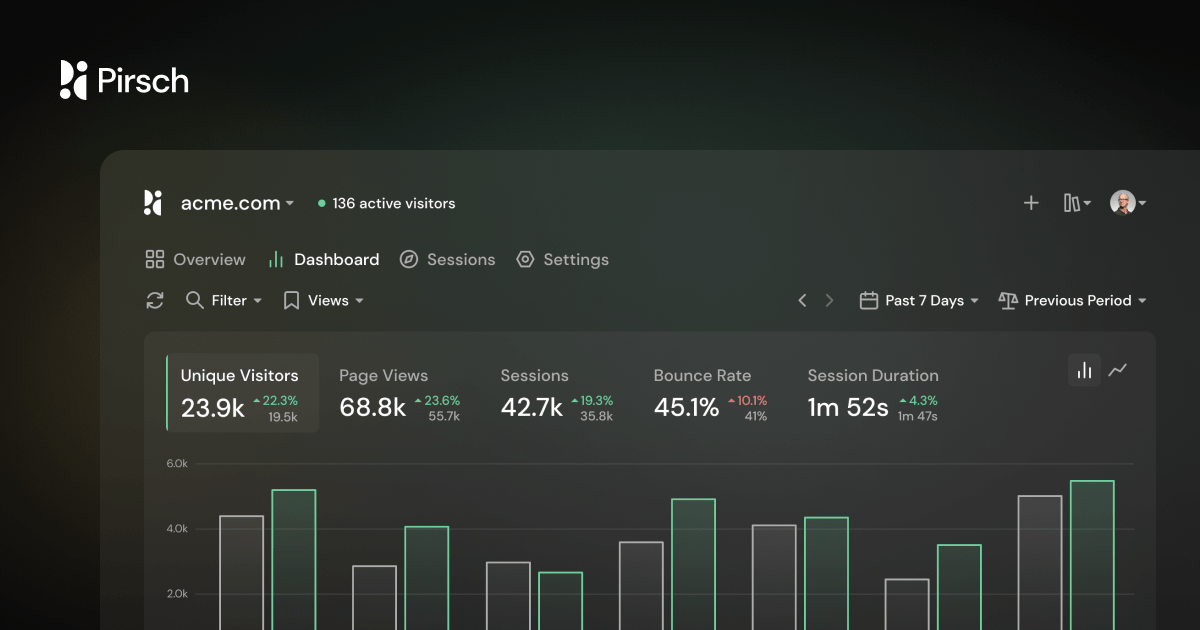
Pirsch is a powerful, privacy-friendly, open-source alternative to Google Analytics — lightweight, cookie-free, and easily integrated into any website or app.
Standard $6/month, Plus $12/month, Enterprise Custom
| Dimension | Score | Evidence | Confidence |
|---|---|---|---|
| Market size | Every website on the internet is a potential customer — hundreds of millions of sites globally. The EU regulatory push alone affects millions of businesses. The TAM is enormous, though the SAM (customers willing to pay for privacy analytics) is meaningfully smaller but still in the tens of millions worldwide. | M | |
| Timing trend | Regulatory tailwinds (GDPR enforcement, ePrivacy Regulation incoming, US state privacy laws) continue to push demand for cookie-free analytics. GA4's unpopularity has driven a multi-year migration wave. AI-powered analytics and first-party data strategies are growing trends that could be layered in. The market is still growing. | H | |
| Defensibility | Pirsch differentiates on Germany/EU hosting, open-source transparency, and a built-in URL shortener — but these are thin moats. Any new entrant can replicate these features. Switching costs are low (analytics scripts are trivially swapped). No real network effects exist. Differentiation angles are limited to hosting region, UI/UX, or vertical focus. | H | |
| Pain severity | Privacy regulations (GDPR, CCPA, PECR) have made cookie-based analytics legally risky. Website owners genuinely fear fines and need compliant alternatives. Google Analytics 4's complexity has amplified the pain of switching, making the need for simpler, compliant analytics acute and ongoing. | H | |
| Willingness to pay | Pirsch's $6–$12/month pricing is validated but extremely low, suggesting price-sensitivity in this segment. Customers pay, but margins are thin. Enterprise tier exists (custom pricing), but SMBs — the core audience — are conditioned to free tools (Google Analytics, Cloudflare Analytics), making upsells hard. | H | |
| Execution complexity | The core product (JS snippet + event ingestion + dashboard) is buildable by a solo developer in months. Open-source frameworks and ClickHouse/TimescaleDB make the data pipeline manageable. However, achieving feature parity with mature players like Plausible or Matomo takes significant effort. EU data residency and compliance certification add non-trivial operational overhead. | M | |
| Competition intensity | This space is extremely crowded. Direct competitors include Plausible, Fathom, Simple Analytics, Umami, Matomo, Counter.dev, GoatCounter, Cabin, and Splitbee — most with similar cookie-free, GDPR-compliant positioning. Plausible and Fathom alone have strong brand recognition and established communities. This is arguably the most saturated niche in indie SaaS. | H |
Reasoning
The privacy-friendly analytics market has genuine, regulation-driven demand and a massive addressable market — but it is one of the most oversaturated niches in all of indie SaaS, with 8–10 well-funded, beloved competitors already fighting for the same cookie-free positioning. A straight clone of Pirsch would be dead on arrival. To compete, a founder must carve out a defensible sub-niche — such as vertical-specific analytics (e.g., for e-commerce, newsletters, or mobile apps), an AI-native insights layer, or a self-hosted-first product targeting enterprise compliance teams — rather than building yet another generic Google Analytics alternative.
No tech stack data